
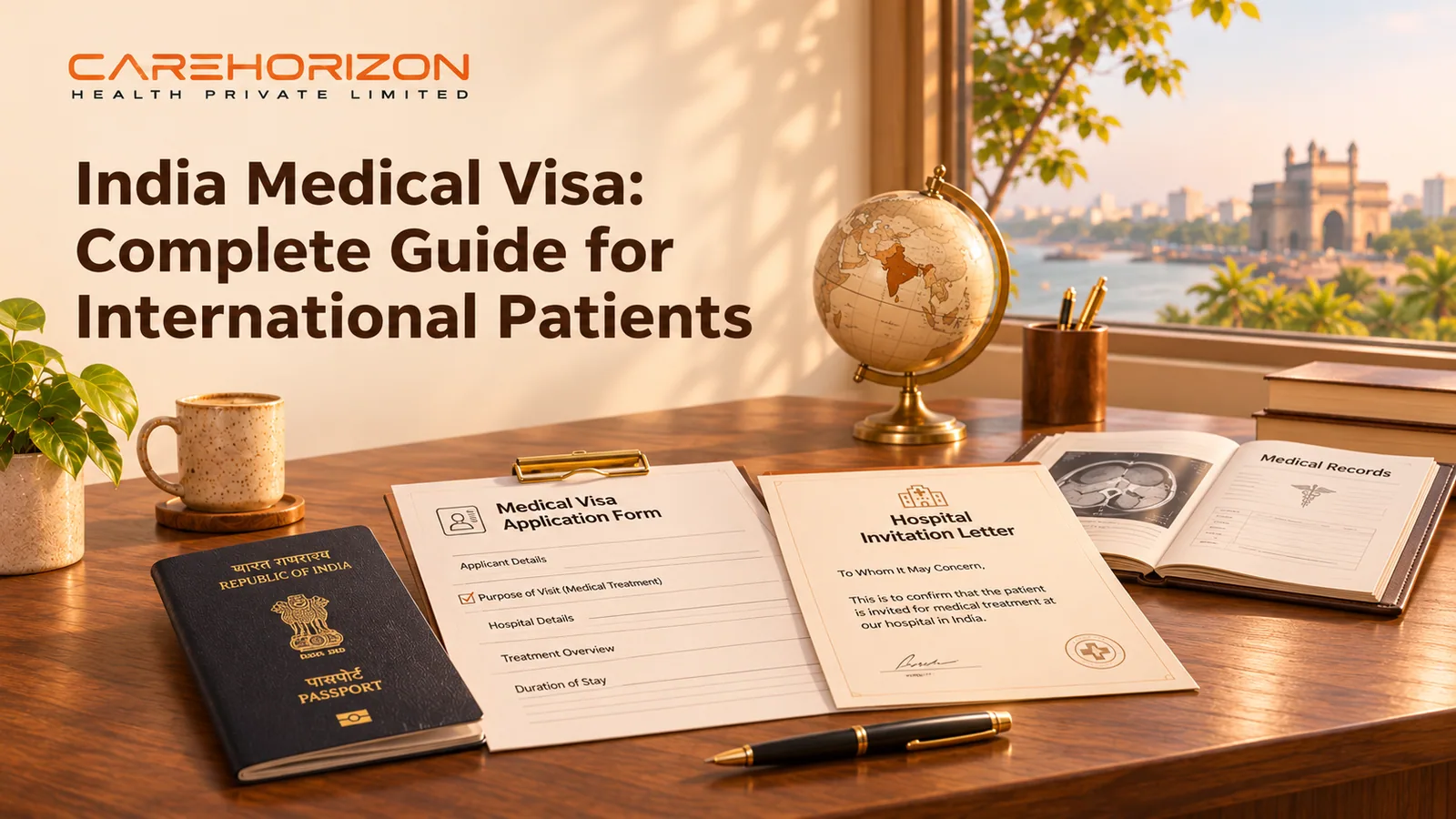
This article provides general information to support better planning. Individual medical decisions and fitness for travel require assessment by qualified treating professionals.
International patients planning treatment in India need to make two distinct arrangements: identify suitable clinical care and obtain lawful permission to enter the country. A hospital may agree to review medical records and issue supporting correspondence, but that does not make a visa automatic. The correct application depends on passport nationality, circumstances, intended purpose and official immigration rules.
India's visa system has an e-Medical option for eligible applicants and regular or nationality-specific procedures for others. An accompanying family member may need a medical attendant visa. Even after permission is granted, the traveller must comply with the authorised entry route and stay conditions. Medical admission, airline clearance and insurance are separate questions.
This guide explains how to approach an India medical visa application, obtain the hospital letter, distinguish e-Medical and regular routes, prepare attendant documents, understand the e-Arrival Card and plan safely for changes in medical treatment. It reflects official government information reviewed in November 2026 and identifies a consequential inconsistency in the government's own validity information.
What Is a Medical Visa for India?
A medical visa is an immigration permission used for an eligible foreign national travelling to India for medical treatment, subject to the visa actually issued. It is not a hospital admission order, treatment authorisation or guarantee of entry at the border.
Before applying, identify the purpose accurately. A specialist consultation and planned treatment may involve different clinical commitments, but the visa route must follow the applicable government's category instructions.
e-Medical Visa Versus Regular Medical Visa
The official Indian Visa Online portal separates electronic visas issued through the Bureau of Immigration from regular visas handled through Indian missions or consular procedures. Eligibility and supporting documents vary.
The electronic route is not available to every passport holder. A patient who does not qualify should use the government-directed regular or nationality-specific pathway, not an unofficial workaround.
Eligibility Depends on Nationality and Passport
The e-Visa website publishes a list of qualifying passports and exclusions, including certain nationality or origin restrictions. Applicants should select their citizenship and read current requirements rather than relying on a third-party summary.
The portal states that each applicant needs a separate passport and that e-Visa is unavailable for diplomatic or official passports and certain non-passport travel documents.
Passport Validity and Blank Pages
The official e-Visa guidance states that passports should have at least six months of validity at the time of application and two blank pages for immigration stamping. Requirements under other routes may differ.
Check the passport expiry date and ensure the patient name and passport number match the hospital documentation and visa form. Errors may require corrections that affect travel.
Medical Treatment and Tourism Are Not Interchangeable
An application should reflect the real travel purpose. Patients should not assume a tourism category lawfully covers a planned medical intervention simply because the application appears convenient.
If an itinerary mixes clinical care and other activities, confirm the correct visa category with official guidance. A medical travel facilitator should not advise misrepresenting the purpose.
What Is an e-Medical Attendant Visa?
The e-Visa scheme offers an accompanying attendant category for eligible travellers. The government portal states that only two e-Medical Attendant visas will be granted against one e-Medical visa.
Each attendant has an individual application, passport and conditions. A family relationship does not automatically grant entry rights, and more than two accompanying relatives should seek official advice about lawful options.
Who May Accompany the Patient?
A spouse, adult child or other family member may need to travel for personal support, but eligibility for a particular attendant category is determined by applicable immigration rules.
Check documents separately for each traveller. Hospital visiting access, consent to share clinical information and accommodation are also separate practical matters.
Why the Indian Hospital Letter Matters
The official e-Medical requirements ask for a letter from the hospital concerned on its letterhead, including the tentative admission or treatment date. The FAQ specifies the patient's name, nationality and passport number.
Ask the hospital to issue accurate documents through an official channel. A letter intended for immigration is different from a clinician's detailed treatment plan, an appointment confirmation or a financial estimate.
For related planning information, see medical visa guide.
What if the Hospital Has Not Confirmed Surgery?
A patient might travel for investigation or specialist assessment before an operation is recommended. The hospital should describe its actual intended clinical purpose and only those dates or arrangements it can confirm.
Do not request an inaccurate guarantee of surgery merely to support a visa. Ask the relevant Indian mission what documentation is acceptable for the particular enquiry.
For related planning information, see medical records organisation guide.
Document Checklist for e-Medical Applicants
The e-Visa portal lists a passport biographical-page scan, a recent front-facing photograph meeting its specifications, and an Indian hospital letter. The online form states the permitted formats and sizes.
Some applicants may need additional evidence under their nationality-specific route. Keep an accurate clinical summary and appointment correspondence available, but do not confuse useful supporting documents with universally mandatory uploads.
Document Checklist for e-Medical Attendants
The official e-Medical Attendant information includes a passport biographical-page scan and an individual application. Requirements for linking the attendant to a patient must be checked in the current official form.
Do not submit the patient's passport details as the attendant's identity. Verify the spelling and validity of each person's travel document.
Step 1: Use the Correct Government Portal
Start at indianvisaonline.gov.in. Read eligibility for the particular nationality and the application route that the government directs the patient to use.
Avoid advertisements or private sites that imitate government branding. The Indian government warns that it has not authorised agents to charge extra emergency or express e-Visa fees.
Step 2: Obtain Authentic Hospital Correspondence
Request the necessary visa-support letter from the chosen hospital's official patient services department. Check the exact facility name, patient details, tentative treatment information and contact details.
Confirm the correspondence independently with the hospital if a third party forwards it. The hospital issues the letter; only immigration authorities can decide a visa.
For related planning information, see sending records to hospitals in India.
Step 3: Complete the Online Application Accurately
Use the current government form, provide accurate identifying and journey details, upload the required photo, passport page and hospital letter, and pay through the official process.
Save the application ID and email address used. An inaccurate passport number, wrong photograph or unreadable scan can create avoidable delays.
Step 4: Monitor Status and Notices
The government portal provides an application-status function. Applicants may be asked to re-upload materials or correct information according to official instructions.
A payment receipt proves a transaction, not visa approval. Check the actual authorised decision and do not rely on a screenshot forwarded by an intermediary.
Step 5: Verify the Issued Permission
After approval, compare the traveller's name, passport number, visa category, validity, entry conditions and applicable destination details with the travel plan.
Do not assume the authorisation is identical for the patient and attendant. Each should verify their own permission and carry the required documentation.
When Should Patients Apply?
The official e-Visa instructions state that eligible e-Medical and e-Medical Attendant applicants may apply at least four days before the planned arrival, within a 120-day advance window.
This is an eligibility window for submitting an application, not a guaranteed processing timeframe. Allow time for document corrections and clinical schedule changes.
Critical Note: Official Visa Validity Is Inconsistent
As reviewed in November 2026, the official e-Visa category table describes certain e-Medical and e-Medical Attendant variants with one-year validity and multiple entries. A FAQ on the same government site still describes a 60-day validity period.
Do not publish one duration as universally correct. The exact visa subtype, approved Electronic Travel Authorization, immigration endorsement and current official advice control an individual's permitted stay. Resolve doubts with immigration authorities before travelling.
For related planning information, see treatment planning in India.
Validity Is Not the Same as Hospital Stay
A clinician may anticipate a short admission and a longer recovery period; an approved visa can have completely different dates or restrictions. A patient should not assume medical instructions extend immigration permission.
Compare medical follow-up dates with the actual immigration conditions and make inquiries early if the patient cannot return within the authorised period.
Extensions and Conversion
The e-Visa FAQ states that e-Visas are generally non-extendable and non-convertible. Individual circumstances should be referred to the competent immigration authority rather than interpreted by a coordinator.
If treatment extends unexpectedly, consult the relevant FRRO or government service before the permitted stay ends. The hospital can explain medical need, but cannot grant lawful extension.
Number of Entries and Repeat Treatment Visits
The current category table identifies multiple-entry medical e-Visa variants, while older explanatory text can differ. Read the specific approval rather than assuming every medical visa works the same way.
This is important for staged treatment, follow-up visits or a temporary return home. Confirm that later travel is lawful before booking repeat flights.
Where Can an e-Visa Holder Enter India?
The official e-Visa portal specifies designated airports and seaports for entry and describes departure from immigration check posts. Lists and approval terms can change.
Do not assume an e-Visa permits arrival at a land border. Check the current government list and the traveller's own authorisation before choosing air or overland routes.
The e-Arrival Card Is Not a Visa
The Indian Visa Online homepage states that foreign nationals and OCI cardholders can submit an e-Arrival Card within 72 hours before arriving in India. The arrival form is separate from the legal entry permission.
Use official government channels for current instructions. Completing an arrival card does not remedy an absent, expired or incorrect visa.
Fees, Payment and Receipts
The official portal states e-Visa fees vary by nationality and visa type, with transaction charges where applicable. Verify the current amount directly during the application.
Visa payments, hospital deposits and travel bookings are separate charges. The government cautions against unauthorised 'express' fee requests and misleading agent promises.
Avoid Fake Websites and Guaranteed Approval Claims
Search advertisements, messaging accounts and imitation forms may resemble the real portal but demand extra payments or sensitive information. Confirm the website address before uploading passports.
No intermediary can promise immigration approval. Keep official records, avoid sending one-time codes, and question any claim of privileged emergency processing not supported by the government.
Bangladesh Applicants Need Nationality-Specific Checks
Bangladesh passport holders should consult the Indian government application route designated for Bangladesh and current instructions from the Indian mission and authorised application centre.
Appointment availability, border routes and hospital-specific restrictions can change. General e-Medical eligibility statements should not replace nationality-specific official guidance.
Other Special Nationality Procedures
The government also maintains distinct visa systems for certain nationalities, including an Afghanistan-specific route with medical documentation requirements.
A rule in a country-specific portal should not be applied to all patients. Use the applicant's actual nationality and passport type to identify the correct process.
Changing Hospitals After Approval
A second opinion or new clinical finding may cause the patient to consider another hospital. Immigration conditions may be relevant where a particular facility is named in the application or approval.
Seek official advice before changing a hospital if the visa imposes facility-specific conditions. An administrative coordinator cannot authorise a visa change.
For related planning information, see choosing a hospital in India.
If Treatment Dates Change
Consultations, test results and surgery scheduling may evolve after a visa application is submitted. Tell the hospital and consider whether its correspondence should be corrected or updated.
Check the authorised visa dates, airline rules and refund terms. A revised hospital plan does not automatically change the visa's permitted duration.
Fitness to Fly Is Separate From Immigration
A visa does not certify the patient's medical suitability for travel. Recent procedures, unstable illness, oxygen needs and other conditions may require clinician and airline assessments.
The medical team advises on fitness and required support. A travel coordinator cannot grant medical clearance or ensure airline acceptance.
For related planning information, see fitness-to-fly questions.
Airport Arrival and Hospital Pickup
Carry the relevant passport, approval information, hospital documents and any required arrival form. Confirm the operating airline, arrival airport, terminal and actual hospital address.
A hospital driver or coordinator may assist with pickup after entry, but immigration control and travel document inspection remain governmental and carrier responsibilities.
For related planning information, see arriving in India for treatment.
Attendant Roles and Hospital Access
A relative may help with communication, mobility and practical needs. Their role is different from that of a medically qualified escort during air travel.
Confirm the hospital's visiting policies and the patient's permission to share clinical information. Professional clinical support must be assessed by qualified healthcare providers.
For related planning information, see guide for medical attendants.
Cost Planning Beyond the Visa
Budget for clinical consultations, treatment, accommodation, transport, meals, attendant expenses, currency conversion and possible extended recovery.
Obtain actual hospital and supplier quotations. A visa-related hospital letter does not define the final medical bill.
For related planning information, see understanding hospital estimates.
Insurance and Visa Approval Are Separate
An insurer may approve or refuse reimbursement independently of immigration and hospital decisions. Planned overseas treatment may be excluded under some policies.
Get a case-specific written insurance response and ask the hospital about direct billing. A visa authorisation is not evidence that a procedure will be covered.
For related planning information, see money and payments guide.
What if the Application Is Refused or Delayed?
Use official status and assistance channels to understand the permitted next steps. Inform the hospital when planned dates are no longer realistic.
Do not use false information or repeated unofficial payments in an attempt to speed up processing. An appointment letter does not entitle an applicant to a visa.
What if the Patient Must Stay Longer?
Unexpected recovery needs may change the departure plan. The hospital can document medical circumstances, while the relevant immigration authority controls any lawful remedy.
Seek guidance before an authorised stay expires. A doctor cannot override visa conditions and a facilitator cannot issue an extension.
For related planning information, see after-discharge recovery guide.
Checklist Before Applying
Confirm the correct route and eligible passport; verify name and expiry date; obtain the hospital letter; prepare the required photograph and scans; and check attendant applications separately.
Use the official website, record the application ID, and distinguish confirmed facts from tentative medical plans.
Checklist Before Departure
Verify the issued visa category, dates, entry port and individual traveller details. Check any e-Arrival Card requirement, airline acceptance, hospital appointment and pickup.
Prepare medical records, relevant medicines, contact numbers, insurance or payment evidence and accommodation suited to the expected recovery.
For related planning information, see documents for treatment in India.
Checklist After Arrival
Follow immigration conditions, attend the confirmed hospital appointment and ask the treating team to explain any changes to care. Keep a record of official visa information and hospital communication.
If the hospital or duration changes, request official advice before assuming any change is automatically permitted.
For related planning information, see returning home after treatment.
Example: Patient With One Companion
An eligible patient receives a hospital letter and applies for an e-Medical Visa. The companion submits a separate application in the appropriate attendant category.
Each person checks their own approval before travel. This fictional example demonstrates individual permissions, not guaranteed eligibility.
Example: Tentative Surgery Date Changes
A specialist requests additional investigations and the original planned surgery date is no longer feasible. The family obtains updated correspondence and checks how it affects the visa and bookings.
The example illustrates why a hospital's clinical timetable and immigration permission require separate checks.
Example: A Planned Land Crossing
A traveller considers a land crossing because it is closer to the hospital. The family checks the particular visa's conditions and the current government list of authorised arrival points before booking.
An itinerary is not lawful merely because a border is geographically convenient. The example is illustrative and does not confirm eligibility for a specific crossing.
How Carehorizon Health Supports Patients
Carehorizon Health Private Limited coordinates practical arrangements around clinical care. Depending on the enquiry, this may include helping organise hospital letters, medical records, appointment correspondence and journey logistics.
Immigration authorities decide visas and entry; hospitals and clinicians determine treatment and admission; airlines determine carriage and insurers determine coverage. Carehorizon does not guarantee visa approval or processing time.
For related planning information, see how Carehorizon works.
Frequently Asked Questions
What is an India medical visa?
It is a form of entry permission for eligible foreign nationals travelling to India for medical treatment, under the conditions of the actual visa issued.
Who qualifies for an e-Medical Visa?
Eligibility depends on nationality, passport type and official criteria. The live Indian e-Visa portal publishes the applicable list and exclusions.
Can all countries use the online medical e-Visa?
No. Certain applicants must use a regular visa or a nationality-specific government process.
Is a hospital letter required?
The official e-Medical instructions require a hospital letter on letterhead with patient details and a tentative treatment or admission date.
How many e-Medical Attendant visas are allowed?
The government e-Visa general instructions state that only two e-Medical Attendant visas will be granted against one e-Medical visa.
How far ahead can I apply?
The e-Visa instructions describe an application window up to 120 days before arrival and a minimum of four days before travel for eligible medical applicants. These are not processing guarantees.
Is the medical e-Visa valid for 60 days or one year?
The government's current pages conflict. Confirm the precise visa subtype, issued permission and current government guidance rather than relying on a generic duration.
Can I enter India by land on an e-Medical Visa?
Do not assume it is allowed. Check the official approved ports and individual entry conditions before selecting a border route.
Is an e-Arrival Card a replacement for a medical visa?
No. The arrival information form is separate from the visa or other lawful entry permission.
Can Carehorizon guarantee an India medical visa?
No. Carehorizon may help coordinate practical documents, but only immigration authorities decide visa grants and entry.
Official Government Sources
- Indian Visa Online — e-Visa and Regular Visa Official Entry Point: https://indianvisaonline.gov.in/
- Indian e-Visa — Eligibility, Documents, Categories and FAQ: https://indianvisaonline.gov.in/evisa/
- Official e-Visa General Instructions: https://indianvisaonline.gov.in/evisa/tvoa.html
- Official e-Arrival Card: https://indianvisaonline.gov.in/earrival/
- Regular Visa Application Portal: https://indianvisaonline.gov.in/visa/
- e-FRRO Services: https://indianfrro.gov.in/
- Official Bangladesh Applicant Route: https://indianvisa-bangladesh.nic.in/visa/
For planned treatment enquiries: Carehorizon Health | WhatsApp/Call +91 6292041222 | care@carehorizonhealth.com | https://carehorizonhealth.com/enquiry/
Legal, immigration, medical and publication disclaimer: General information reviewed on 12 November 2026, not a government decision, legal advice, guarantee of visa approval or processing time, hospital admission promise, medical advice or fitness-to-fly clearance. The official government portal contains conflicting statements about medical e-Visa duration; applicants must verify their own permissions and current rules. Hospitals and qualified clinicians determine care; immigration authorities determine visas and entry. Internal Carehorizon URLs were drawn from the supplied inventory and must be verified live before publication.
Carehorizon Health coordinates medical travel, patient transfers and related arrangements. The information here is educational; it does not diagnose, prescribe, guarantee an outcome or replace advice from your treating medical team. Service availability, costs and travel requirements are confirmed case by case.


